You Know Has Made a Fool of You Old S Buddy Holly Ong
Buddy Holly
When anyone says "Rock `north Coil pioneers," simply a few musicians authorize as existence influential in establishing the genre, circa mid 1950s. Chuck Berry is one. Elvis Presley is another. Merely in the cursory span between July 1957, when his offset successful unmarried, "Peggy Sue," was released, until his tragic death in February 1959, Buddy Holly left an impression as deep as if he had been in the business for decades. His enthusiastic and energetic "rockabilly hiccup," male child-loves-girl mode put his indelible stamp on the music destined to exist America`due south — indeed, much of the globe`due south — favorite. 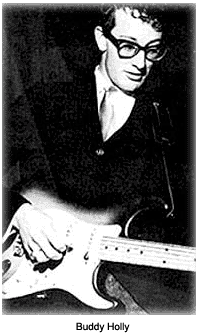 Such artists every bit John Lennon and Paul McCartney, who attended a Buddy Holly and the Crickets concert during Holly`s tour of Great U.k. in 1958; the Rolling Stones, who used Holly`s "Not Fade Abroad" for their fist large hitting; the Byrds, Turtles, Elvis Costello, Johnny Greenbacks, and Don McLean credit Holly for influencing their music. The early years Buddy was born in Lubbock, Texas, in September 1936, as "Charles Hardin Holley. Due to a misspelling on his commencement contract with Decca Records, information technology was written as Holly. He decided to keep the new proper name. Buddy hailed from a musical family, having three older siblings who played guitar, piano, violin, banjo, mandolin, and steel guitar — which he didn`t like after a few lessons. Buddy and his two brothers entered a talent contest when he was about 10 years old. He played a violin; the strings had been greased to suppress the screeching. At the age of thirteen, Buddy joined with childhood friend, Bob Montgomery, to form their first band, "Buddy & Bob." They wrote some rough-edged tunes, influenced in part by state-western music, and called them "Western Bop." A shakeout of sorts occurred as the group matured in the mid 1950s. Montgomery wanted to stay with mainstream western, while Holly liked what Elvis and Beak Haley were doing with their upbeat styles. The road to distinction The years 1956 and 1957 were pivotal to Holly`s success. He traveled paths less taken by adding a drummer, Jerry Allison, to the group. That was a departure from the standard country-western mode of doing things. An upright bass and rhythm guitar, coupled with Holly`south lead guitar, the famed Fender Stratocaster, completed the ensemble, now dubbed the "Crickets." Following some unsuccessful demos for Decca, they entrenched themselves in Norman Trivial`s studio in Clovis, New Mexico. Past that time, Niki Sullivan had joined the band as rhythm guitar player. With a violent dedication to their music, the band worked feverishly to tighten upward the tunes they thought had the most hope. The first result of that effort was "That`ll Be the Mean solar day." The title came directly from a John Wayne picture show, The Searchers, in which Wayne had muttered, "That`ll exist the day!" That was quickly followed by "Peggy Sue," which was actually released before "That`ll Be the Twenty-four hour period," and "Oh, Boy." Anecdotally, "Peggy Sue" was originally titled "Cindy Lou," only information technology was inverse to help drummer Allison pursue his high-school flame, Peggy Sue Gerron. Appearances on the K Ole Opry show with country-western greats Ray Toll, Ruby Sovine, Cash, and Perkins, as well as Dick Clark`s American Bandstand, elevated the Crickets` public personae. They rode the wave of popularity like a champion surfer hangin` 10. At i point, they were booked into the Apollo Theater, a predominately African-American venue, in New York City. Afterwards the initial shock of both audience and performers when the drapery went up, Buddy and visitor soldiered on, and by the end of the gig were receiving enthusiastic applause. The band had successfully bridged the racial gap with their style — some of which was borrowed from one of their ain — Chuck Berry. Holly`s band continued to write their ain singles, every bit opposed to Presley and others in the business who merely sang songs that were written for them. In the fall of 1957, they released "Maybe Infant." "Rave On" and "Well, All Right" followed in the the first two months of 1958. "It`s So Easy" and "Honey`due south Made a Fool of You lot," connected the hit parade in the jump and summer. In August, Holly took a short break to marry Maria Elena Santiago, and in short society, they were expecting. Holly wrote "True Beloved Ways" for his bride, and she claimed that it was her favorite of all his hits. The large breakup In the autumn of `58, the grouping began to fall autonomously. One of their concluding appearances together was too Holly`s last evidence on American Bandstand. It was besides well-nigh that time that "Peggy Sue Got Married" was released, along with other, less-touted tunes: "That Makes it Tough," and "Crying, Waiting, Hoping." Holly decided his creative style was cramped by the group and producer Piddling, so he split to make his own way. He quickly joined the "Wintertime Trip the light fantastic toe Party" tour of the upper Midwest. His new group consisted of a immature Waylon Jennings on bass, Tommy Allsup on lead guitar, and Carl Bunch on drums. Holly combined on the tour with such other talent every bit Ritchie Valens, J.P. Richardson, a.yard.a. the "Big Bopper"; Dion, and others. Aside from his established hits, Holly introduced "Gotta Travel On," "Everyday," and "Heartbeat." He arranged for a group rendition of Berry`s "Chocolate-brown-eyed Handsome Homo," and for his encore, did "Not Fade Abroad," "Bo Didley," and "Rave On." An unidentified historian adds that Holly also performed "Whole Lotta Shakin` Goin` On," and "Be Bop A Lula." Wintertime dejection The Winter Trip the light fantastic Political party`s concert in Duluth, Minnesota on January 31, 1959, was attended past Robert Zimmerman, who later launched his music career as Bob Dylan. Zimmerman was treated to a concert that included the Big Bopper, who sang his standard "Chantilly Lace;" Valens chimed in with "Come On, Let`s Go," "Donna," and "To Know Him is to Beloved Him." Dion sang "Teenager in Love" and "The Wanderer," before Valens airtight with a lively tune chosen "La Bamba." Following the concert, reality hit. While they were performing, everyone was warm and toasty, but when it was time to ride the bus to their adjacent location, at that place were some chilly individuals by morning because the omnibus heater was on the fritz. A second bus had the same problem. On the afternoon of February 2, Holly chartered an plane, a Bonanza Beechcraft, to get them to Fargo a little early for their next functioning, then they could remainder and catch upwards on their laundry. Holly boarded the plane shortly after 1 a.m., February 3, forth with Richardson, who, because he had the influenza, took Jennings` seat. As well aboard was Valens, who had won a coin flip with Allsup for the final seat, along with pilot Roger Peterson. They took off into a blinding snowstorm, Peterson hoping to climb to a higher place the clouds. Seven miles west of the airport in Mason Metropolis, Iowa, the aeroplane went down in a corn field nearly Clear Lake. There were no survivors. Buddy Holly remembered In his vocal, "American Pie," Don McClain eulogized Holly and the others on that plane by referring to February 3, 1959, equally "The Day the Music Died." Every bit for Allsup, he started a bar called the "Heads Up Saloon," to pay tribute to Valens who had chosen "heads" on that fateful coin flip. Halls of fame Buddy Holly was among the first to exist inducted into the Rock `n Roll Hall of Fame in Cleveland, Ohio, in 1986. He also was inducted into the Rockabilly Hall of Fame in Burns, Tennessee, nigh xxx miles west of Memphis.
williamstores1988.blogspot.com
Source: https://www.u-s-history.com/pages/h3809.html
0 Response to "You Know Has Made a Fool of You Old S Buddy Holly Ong"
Post a Comment