Make It All Better Again Atmosphere Genius
The mystery of 'lost' rock genius Lee Mavers
(Image credit:
Getty Images
)

Just over 30 years ago, band The La's released their sole LP – a masterpiece that shaped guitar music. But its brilliant frontman has been elusive ever since, writes Shaun Curran.
L
Lee Mavers is the frontman, songwriter, and creative force of The La'south, a British band from the northern city of Liverpool. The La'due south but made 1 album, enjoyed just one hit single and haven't released a note of new music since 1990. Yet the band's legacy and place in rock history supersedes their slim output. That single, There She Goes, remains equally perfect a piece of guitar popular as anything since their Liverpool forebears The Beatles and is the crown jewel in a treasured canon that has become a touchstone for generations of bands. The La'due south helped to usher in the 90s Britpop era in British guitar music, led past the likes of Oasis and Mistiness – Noel Gallagher once declared that "Oasis want to stop what The La'south started" – while their influence has stretched beyond that to bands from The Libertines to Chill Monkeys and Fontaines DC. "It's like The Velvet Undercover," says former La's guitarist Barry Sutton. "Maybe not anybody knows well-nigh The La's, but anybody who did went out and formed a band or was touched by [the music] in a really deep way".
More like this
– The pictures that made Bowie an icon
– The false myth of John Lennon
– The fake Beatles who conned Due south America
It says everything about the calibration of Mavers' talent that his reputation as a genius is based on such little recorded material. Merely his beautifully succinct songs, covered by artists ranging from Robbie Williams to Pearl Jam, take placed him in the lineage of classic songwriters, winning a devoted post-obit and the adoration of music legends. In 1991, Eric Clapton told Rolling Stone that "the only thing I've really liked (recently) is a guy chosen Lee Mavers… he'due south got a stance and a style that I recall is tremendous", while in 2013 The Smiths' former guitarist Johnny Marr told Q magazine that Mavers "is as proficient as everyone thinks he is".

The La's (hither photographed in Liverpool in 1990) helped to conductor in the 90s Britpop era in British guitar music (Credit: Getty Images)
Yet Mavers is at present considered by many to be one of popular'southward great "lost" figures. Over the last 3 decades, he has steadfastly refused to release any of the songs he's written. Since 1991, Mavers has played only xx official concerts, the last of which was nearly ten years agone. His public appearances are and so deficient that for some journalists, tracking him down became a holy grail: Matthew Macefield wrote an entire book, 2003'southward A Underground Liverpool: In Search of The La'south, defended to his four-yr quest to go an audience with Mavers, which he eventually did at his Liverpool home. His enigmatic nature is one reason why, with rock music currently lacking truly bohemian figures, Mavers however holds the imagination of not just fans, but the press and industry at large: despite years of inactivity, his status is such that as recently as 2015, he was rumoured to be working on music with Liam Gallagher.
Recently jubilant its 30th anniversary, the La'southward self-titled debut is a cult album in the truest sense. It simply reached number 30 in the charts and sold relatively few copies on release. Influenced by The Beatles, The Who, Love and Pink Floyd, its acoustic rhythms, 1960s sensibility and pure melodicism were at odds with the era'south prevailing scenes of Madchester, grunge and shoegaze. But it is precisely that ageless quality that has weathered and so well. Songs like Timeless Tune and the epic Looking Glass display a rare gift for songwriting that continues to endure.
Yet the album'southward legendary condition rests not so much on its phenomenal songs as the bizarre and tortured nature of its recording, which involved Mavers and a revolving door of ring members and producers. It is a recording that has only become more infamous over fourth dimension, with many stories and rumours developing about Mavers' obsessive perfectionism and chaotic studio behaviour – one urban legend said Mavers would assemble authentic 1960s dust to sprinkle on instruments in order to cultivate the correct vibe.
The ring's rocky evolution
For The La'due south fanatics, separating fact from fiction has always been part of the appeal. This is a band where cipher is always as information technology seems. Despite being the main protagonist, Mavers didn't even form The La'southward (named after both the musical note and the Liverpudlian abridgement of "lad"). That was musician Mike Badger, who started the band on his own in 1983 in a city of Liverpool that, in the midst of the Thatcher era, was "washed away on a tide of heroin, despondency and unemployment," according to Badger.
Annoy and Mavers had briefly met in 1981, merely reconnected later on a chance meeting at the city's Everyman Theatre in 1984. They hit up a rapport, bonding over Captain Beefheart, and were soon working on each other's songs. "He was a very funny guy, very talented, very cool guy," Badger tells BBC Culture. "When he played guitar I was similar 'there's no one like him'". Afterward enlisting ii other members – John Power on bass and Paul Rhodes on drums – the quartet started to gain a considerable following and put down demos of many of the tracks that would make upwards their debut album. "Nosotros'd done all the work, and that's when all the issues started," Badger says. Over time, Mavers had get less interested in Annoy'south contributions, and increasingly confrontational. A pre-gig fight in December 1986 saw Annoy exit his own group. "[Mavers] said to me 'your time's nearly up in this band'. I was like 'what? Information technology's non your band mate!' I said 'I'm off', packed my guitar and got on the bus. I was gutted. Two years' work gone overnight".
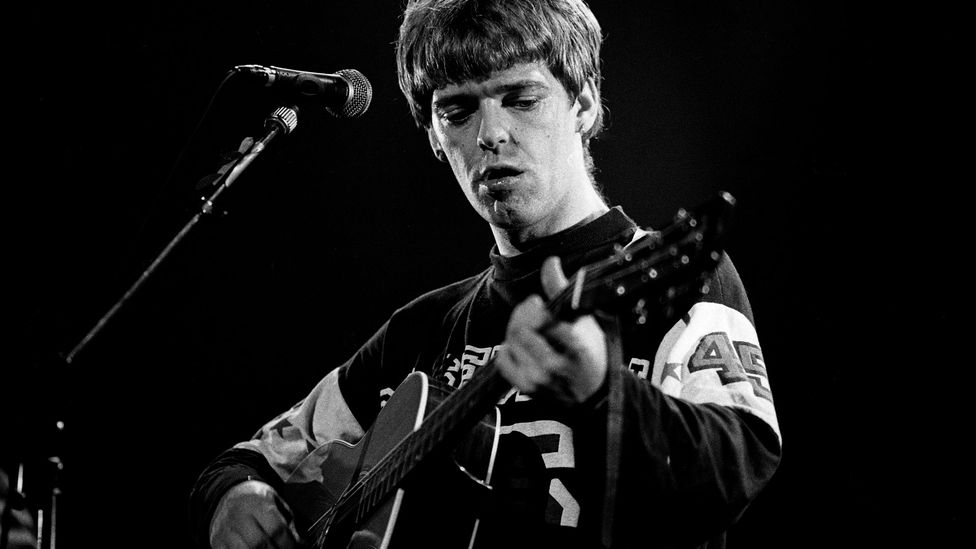
After Mike Badger left, Lee Mavers became the sole pb of the ring, and set about capturing his vision with a succession of guitarists and drummers (Credit: Getty Images)
As The La's songwriter and sole lead, Mavers now had complete control of the band. Past 1987, they were newly signed to London label Get! Discs, and armed with great songs and a clear thought: capture the organic sound of their demos for a double album to exist named Callin' All. Simply nothing, or nobody, could meet Mavers' exacting standards. The purity of his vision proved incommunicable to recreate. Producers, including John Leckie (The Rock Roses, Radiohead) and Mike Hedges (The Cure, Manic Street Preachers) were hired and fired, guitarists and drummers rotated at will. Sutton joined in 1988, and lasted a twelvemonth. "I don't want to make Lee out as a bad guy, considering he'south very funny. But the atmosphere he creates isn't conducive to people doing their best work," he says, reflecting on his brusque stint. "There'due south a lot of attention paid to the exact phrasing of parts, strange guitar tunings, a lot of pressure. My playing was suffering, I [was] deeply paranoid all the fourth dimension. When I was sacked it came as a relief."
In Dec 1989, Go! Discs turned to producer Steve Lillywhite (U2, Unproblematic Minds), who was initially blown away past Mavers' talent. "Give him an acoustic guitar and pound for pound he's better than anyone. He was dynamite, an amazingly creative person," Lillywhite tells BBC Culture. But familiar problems reared their head. "It was like a game of snakes and ladders," says Lillywhite. "At any point in making the anthology he heard something he didn't like, information technology was back to square one".
Go! Discs eventually ran out of patience, and asked Lillywhite to put the album together from the available tapes. Finally, after 12 studio sessions, 10 band members, vii producers, and iii years of recording at an estimated cost of £1million, the album was released on 1 October 1990 to widespread critical acclaim. Mavers immediately disowned information technology. "I hate information technology," he told NME's Stuart Maconie at the time. "There is not 1 good thing I tin discover to say about it… it'due south like a snake with a broken dorsum".
Lillywhite is philosophical about Mavers' criticisms. "When I heed to the album now I'm still happy, it has some magical moments. But he's the artist: if we didn't go the sound he wanted, we failed. I'll stand with him on this 1".
A retreat from the public eye
The La'due south limped unhappily on before disintegrating following the departure of Power in December 1991. Power, who went on to enjoy success during the Britpop boom as the frontman of some other ring, Cast, had been a loyal lieutenant and harmonious musical foil. Without him, The La'southward as everyone knew them were over. Mavers retreated from the public eye, intent on re-recording the songs from their ane and but album to his satisfaction. In his absence, the rumour mill in Liverpool – ever the storytelling city – went into overdrive. As detailed in A Secret Liverpool: In Search of The La's, the stories ranged from the amusing to the concerning to the ludicrous: he'd become a painter and decorator; he was a heroin addict; he had actually written Paul Weller's 1995 hit The Changingman. Perhaps all-time of all was the story that Mavers was living in a monastery, where monks had alleged him as talented as Mozart.
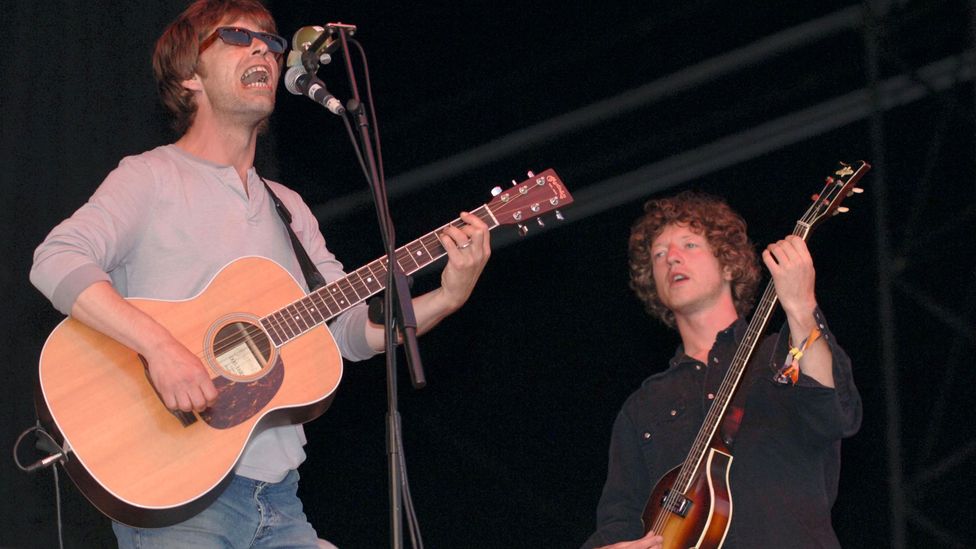
Mavers and John Power came together over again for a 2005 tour, which included an appearance at Glastonbury, merely the reunion was short-lived (Credit: Getty Images)
These kind of myths are crucial to the cult of Mavers. But the truth is far more prosaic. Very few of the stories – sadly, not even the fabulous 1960s dust – have always been corroborated, while Mavers categorically denied the Weller story to Macefield. Even ane that was truthful – Mavers did succumb to heroin habit in the 1990s, as he confirmed to writer Daniel Rachel in his 2013 book Isle of Noises: Conversations with Cracking British Songwriters – sparked off another myth, that There She Goes (with its "there she goes once again/pulsing through my vein" lyric) was almost the drug. Badger writes in his own volume, 2015'south The Rhythm & The Tide: Liverpool, The La's and the Ever After, that Mavers confirmed to him the rumour was untrue.
All the while, fans have waited expectantly for new music – but it has never arrived. Mavers has spent the intervening years assembling various curt-lived incarnations of The La'southward, forever determined to rerecord that lone debut album while also working on his new songs. In 1999, at that place was even a undercover reunion between Mavers and Annoy. "His new songs are great," Badger says. "I gave it vi months – but information technology was just same stuff, different year with his obsessive behaviour. I wish Lee well, but I simply couldn't go there."
Not even an improbable 2005 reunion tour, with Power back in the fold, brought nearly the mythical 2nd album. Mavers has barely been seen since, save some guest appearances with Pete Doherty in 2009 – a supposed programme to record with Doherty's ring Babyshambles predictably never materialised – and a short stripped-back tour in 2011 with local Liverpool musician Gary Murphy. More than 30 years on, fans are left to infamous online bootlegs of La'south songs never officially recorded to hear glimpses of a promised hereafter. The hazard of Mavers releasing new music looks more remote than ever.
I attempted to contact Mavers for this piece but, with no tape company or direction, he unsurprisingly proved elusive – one person told me sightings of Mavers were then rare he was like a "Scouse unicorn". My email to the accost on The La's official Facebook page bounced back every bit the inbox was full. I asked interviewees and contacts in the Liverpool music scene for a lead: some were reluctant to help, others tried to contact Mavers through third parties. Only promising trails led nowhere, which seems like an apt metaphor.
Separating myth and reality
In that location are numerous theories as to why he has been and so reluctant to go on his musical career, publicly at least. Badger thinks that the omnipresence of In that location She Goes, covered past the Usa band Sixpence None The Richer, and a become-to track for romantic moments in flick and TV, has been a expletive for Mavers as well every bit a approving. "It's the best thing that's happened to Lee merely also the worst," he says. "He wrote this perfect vocal, just information technology's meant he hasn't had to practice anything considering he has a constant source of income."
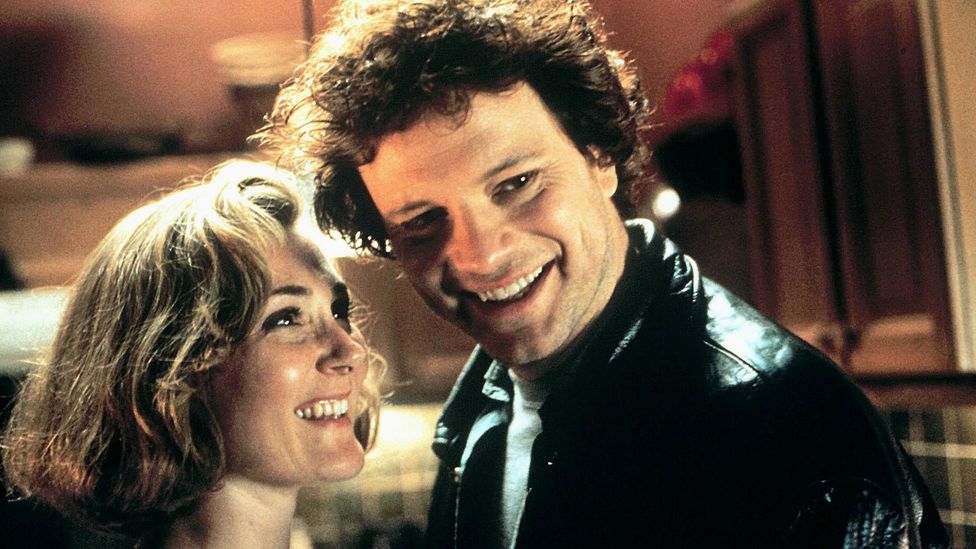
The La'due south song There She Goes has made many soundtrack appearances, including in 1997 romantic comedy Fever Pitch (starring Ruth Gemmell and Colin Firth, pictured) (Credit: Alamy)
Rachel – the only person to take a sit down-down interview with Mavers in the last 19 years, for his aforementioned 2013 book – believes Mavers' public inaction is the result of the farthermost creative integrity of a songwriter unwilling to release cloth that falls curt of his specific ideals. "If he has a sound in his head and he doesn't hear that when he records, then that'south a peachy travesty [for him]," says Rachel. "It'south extraordinary to hold [yourself to such unforgiving standards] for this amount of time. In that location's no precedent for this at all in rock'n'gyre history. But why should he compromise? He's non that type of creative person".
Any the reasons for Mavers' decision to retreat from the music industry, perchance it shouldn't be a surprise. The lyrics on The La's hint at a soul unhappy with his situation. Throughout the album Mavers sings of being lost, bound, chained, tied, looking for freedom, needing a tune to unblock the thoughts circling his mind. Some lyrics seem to predict what was to come: given his reported preoccupation with rerecording the album, the very opening lines "If you want I'll sell yous a life story/about a man who's at loggerheads with his past all the time" now sound particularly prophetic.
Yet the image of Mavers as the tortured artist needs reassessing. From Brian Wilson to Syd Barrett – to whom Mavers is often compared – the myth of the doomed musical genius suffering for their fine art pervades popular culture, perpetuating the idea that ache equates to greatness. But Mavers has rejected that characterisation of him in the by. He told Rachel mockingly: "All the Syd Barrett [stuff]… thanks for giving me that card. I'll play it every fourth dimension… I couldn't have invented it".
In truth, Mavers is happily living in a suburb of Liverpool, long since clean from drugs and a committed family man. "I'm a male parent now," he told Rachel. "I haven't done any of that [drugs] for decades… I'm just a fellow that'south got four kids and just living and observing every bit anyone could". Mavers seems content with a quiet life, interested in music purely for its own sake, free from its commercial shackles and expectations. Every bit much equally the narrative of what might have been keeps fans interested, maybe this remarkable talent has given all he wishes to requite. "I don't think we've lost anything," says Rachel. "He gave me something that's stayed with me all of my life."
Even as the concept of the reclusive genius gets closer to extinction in this oversharing, social media age, it is arguably to Mavers' credit that he remains equally unattainable and unknowable as e'er. Simply for all the myths and legends surrounding him, perhaps it's worth remembering what Mavers told Macefield: "I'm only a man, la. Just a person".
The La's Callin' All: 1986-1987 LP is bachelor on Mike Badger's Viper Label.
If you would similar to comment on this story or anything else you have seen on BBC Civilisation, caput over to our Facebook page or message us on Twitter .
And if yous liked this story, sign up for the weekly bbc.com features newsletter , called The Essential List. A handpicked pick of stories from BBC Future, Civilization, Worklife and Travel, delivered to your inbox every Fri.
williamstores1988.blogspot.com
Source: https://www.bbc.com/culture/article/20210315-the-mystery-of-lost-rock-genius-lee-mavers
0 Response to "Make It All Better Again Atmosphere Genius"
Post a Comment